The Top Tech Transfer Risks at Multi-Site CDMOs (And How to Mitigate Them With a Single-Site)
Tech transfer is one of the most consequential — and risk laden — moments in the lifecycle of an active pharmaceutical ingredient (API). When a process moves from development into scale up, even the smallest gaps in documentation or process understanding can quickly translate into timeline delays or data discrepancies. These challenges are amplified when a sponsor’s API must be transferred between multiple sites, even within the same contract development and manufacturing organization (CDMO).
Multi-site tech transfers can introduce handoffs between teams, facilities, and operating practices, increasing the likelihood of miscommunication, operational disruptions, and lost institutional knowledge. By contrast, a single site CDMO model — where development, scale up, and commercial manufacturing occur on one campus — can reduce these risks by keeping process expertise, analytical insight, and decision making tightly connected. Understanding how site structure affects tech transfer execution is critical for sponsors looking to accelerate scale-up while maintaining control over quality and timelines.
Multi-Site Challenge: Lack of Transparency and Communication
When a tech transfer occurs across sites from one CDMO to another, or even within the same CDMO, i.e., transferring a kilo lab process to a pilot plant or to a commercial manufacturing facility, communication failures can pose significant risk. Site-to-site tech transfers are typically initiated by the sending site providing a document detailing an existing process and analytical methodology to a receiving site. Often, this documentation is incomplete and difficult to decipher for the receiving site. Generally, process development activities at laboratory scale include more than a defined process ready for scale-up; the process chemists also learn valuable knowledge from unsuccessful experiments. Failed experimental results are rarely shared in tech transfers and therefore, more fundamental process understanding is lost.
Even if documentation is thorough, each facility has distinct procedures and unique features that make a truly flawless transfer difficult; there are simply key aspects of a process that are challenging to parse from a document. Operators at the receiving site may not fully recognize why certain steps are critical and may lack onsite access to the subject matter experts who developed these steps. To effectively secure the insight of previous operators, receiving teams often must travel to the sending site to view equipment and techniques in person, leading to lags in implementation and understanding.
Single-Site Solution: On-Site Consistency and Collaboration
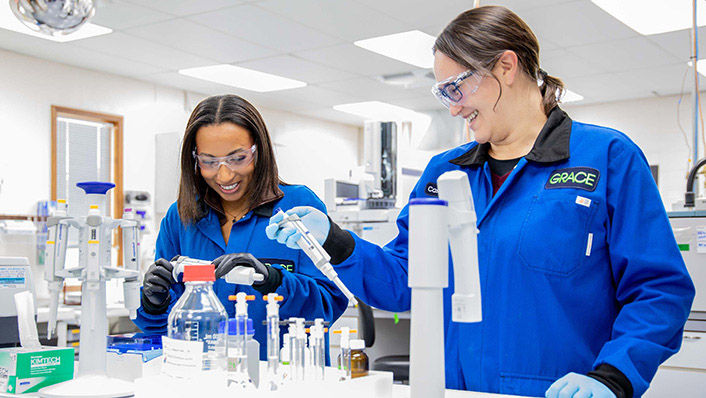
At W. R. Grace & Co.’s (Grace) Fine Chemical Manufacturing Services, our R&D lab, kilo lab, pilot plant, and commercial production facility are all located on the same campus, functionally eliminating the communication challenges of a multi-site tech transfer. With these operations localized, chemists, engineers, and quality control teams brainstorm scale-up solutions by walking next door, assessing equipment, and asking questions about processes and analytical methods. While multi-site teams conduct these conversations remotely — which can result in communication delays and back and forth correspondence— Grace’s single-site teams discuss tech transfer obstacles face-to-face.
Our tech transfers benefit from on-site institutional knowledge. Although processes are transferred from lab to plant through rigorous, standardized documentation with consistent process and analytical data, stakeholders also participate in both formal and informal exercises. We leverage consistent batch records and formalized meetings as well as impromptu Q&A sessions and existing relationships between teams. This accessibility allows, for example, a plant operator to readily consult a chemist to understand why a process step is critical and how to best approach it to mitigate risk.
Key players are involved at each stage to ensure smooth scale-up. Grace’s Senior R&D Process Engineer oversees both the kilo lab and first-time scale-up in the pilot plant, easily aligning process parameters and batch records thanks to existing knowledge of why each step is required. In many cases, our customers’ operations will be run by the same dedicated program team from the kilo lab to the validated manufacturing process. Our program teams include experienced representatives from analytical services, R&D, engineering, operations, and quality, while also providing technical and regulatory support as needed. We take pride in our continuous customer service and feel a shared sense of ownership, remaining as committed to a sponsor’s FDA approval and success as they are.
Multi-Site Challenge: Timeline Delays
Multi-site documentation discrepancies can contribute to tech transfer delays, as receiving teams struggle to piece together how processes are meant to run from an analytical standpoint. Once the receiving team gains clarity on process architecture, technicians will need to spend time in the lab becoming familiar with the chemistry of the transferred workflow. This training period results in further delays.
There are also potential slowdowns associated with transferring an analytical method developed in one lab to another; even if an analytical method is validated, that does not mean it will function in any lab with any piece of equipment. When the receiving site must troubleshoot why a validated analytical method is not performing as intended during tech transfer, the additional time may delay production. For sponsors that need rapid tech transfer and scale-up to meet clinical milestones and secure additional funding, such setbacks can be highly disruptive.
Single-Site Solution: Eliminate Extraneous Steps and Derisk Scale-up
With Grace’s same site facilities, our chemists are already familiar with the chemistry behind a process and do not need to conduct additional lab-scale runs to understand it. This existing knowledge enables speed of tech transfer and scale-up from the kilo lab to the pilot plant. If sponsors need to move quickly, we can easily accommodate high-speed onboarding and start up.
Our chemists and engineers also collaborate on technical risk assessments during tech transfer to anticipate quality issues that might arise during scale-up. After executing a baseline run to establish process performance data, we conduct targeted experiments to test process robustness and mitigate any identified risks prior to scale-up. Following the experiments, we designate identified or perceived risks into three categories: low, medium, or high. Higher risk items are prioritized as requiring a mitigation strategy to further reduce potential operational challenges and possible product quality concerns if not addressed before scale-up. Risk assessments are expected by FDA reviewers and are essential to building a scalable, lower-risk process.
Multi-Site Challenge: Gaps in Site Equipment and Procedures
When conducting a tech transfer from one CDMO site to another, there are often gaps in analytical method documentation, including procedures relating to equipment and consumables that may not be well defined. Even within the same company, different sites may have discrepancies between how their equipment is configured or even the types of consumables or raw materials that they use, e.g., vials, solvent grades, etc. This can result in delays as operators work to retroactively detect which factors are causing faulty processes and/or quality issues.
Single-Site Solution: Harmonize Approaches
Grace leverages harmonized approaches across our campus. We utilize the same laboratory equipment and consumables at different scales across kilo lab, pilot plant, and commercial production. Our consistency across manufacturing spaces helps eliminate major development efforts and shortens tech transfer and implementation timelines. At Grace, safety is not just a priority, it is a value that guides behavior and decision making for every employee. Our teams are committed to being responsible stewards for our environment and communities by striving to ensure safety across people, processes, and products.
The Single-Site CDMO Advantage
The risks associated with tech transfers are not inevitable, especially with a single campus CDMO. By collaborating with an organization that houses all manufacturing facilities at one site, drug sponsors can overcome obstacles while maintaining speed on their journey to market. At Grace, we offer customers continuity and institutional knowledge that are vital to transferring a process from lab to commercial scale manufacturing. Our efforts are focused on derisking the API’s pathway to patients and fostering a long-term partnership in our clients’ projects.